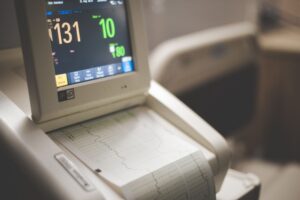


I arrived at the hospital prepared for contractions, cervical checks, and possibly a C-section. I was not prepared to have my digestive system professionally pressure-washed before sunrise.
When I tell people about my birth story, they expect me to start with labor—the contractions, the induction, the fetal monitors, or the dramatic decision to have a C-section.
Instead, I start with the enema.
Because honestly? The enema was the most violent part of the entire experience.
Let me explain.
Arriving for My Induction
I arrived at the hospital at 2 a.m. for my induction feeling surprisingly calm. Was I nervous? Absolutely. Was I excited? Of course. Was I ready? As ready as a first-time mother carrying a baby estimated to weigh more than nine pounds could possibly be.
I had spent months preparing for labor. I watched videos, read articles, listened to birth stories, and scared myself thoroughly on social media. I had mentally prepared for contractions, pain medication, pushing, and the possibility that things might not go according to plan.
What I had not prepared for was somebody unexpectedly shooting liquid into my butt before sunrise.
Around 3 a.m., I drifted into one of those strange hospital half-sleeps. You aren’t truly asleep because machines are beeping, lights are glowing, and people keep walking into your room. But you aren’t fully awake either. You are simply lying there with your eyes closed, pretending the blood-pressure cuff isn’t about to squeeze your arm for the seventeenth time.
Then the nurse entered the room, and things began happening very quickly.
Before I fully understood what was going on, I was turned onto my side. In my personal recollection of events—and this is how it will forever exist in my memory—that nurse inserted a tube and unleashed chaos.
To be fair, she was probably performing the procedure exactly as she had been trained.
But memory is not always fair.
And in my memory?
Violence.
Pure violence.
The Battle Began
The second that liquid entered my body, I knew my life had changed. There are moments when you realize you have approximately five seconds before disaster strikes.
This was one of those moments.
The nurse left, and I remained completely still for what felt like an eternity. One minute passed. Then another.
Then the battle began.
I launched myself toward the bathroom with a level of speed and athleticism that had been missing throughout my entire pregnancy. Apparently, all I needed to restore my mobility was the immediate threat of public humiliation.
What followed was approximately twenty minutes of uninterrupted destruction. It came in waves. Every time I thought the situation had settled, another attack arrived. I couldn’t leave the bathroom because I didn’t trust my body, my future, or gravity itself.
At one point, I remember thinking, “So this is how it ends.”
Not because I was dying.
Because I was exhausted.
By 4 a.m., every piece of stubborn constipation that had been living rent-free inside my body for months had officially been evicted.
Every. Single. Piece.
Gloriously Empty
The strangest part was that once it ended, I felt fantastic. I felt lighter, freer, and almost athletic. If someone had asked me to run a 5K immediately afterward, I might have considered it.
For the first time in months, I didn’t feel backed up, bloated, or miserable.
I felt empty.
Gloriously empty.
One of my secret fears throughout pregnancy had been pooping during labor. I knew it was common. I knew labor-and-delivery nurses had seen it countless times. I knew nobody in the room would care.
None of that knowledge made me feel better.
The enema eliminated that concern entirely. At that point, there was nothing left to poop. Nothing. Not even a possibility.
My body had been professionally pressure-washed.
Are Enemas a Normal Part of Labor?
This is important: my experience does not mean everyone receives—or needs—an enema before an induction or vaginal delivery.
Enemas were once used more routinely because healthcare providers believed they might reduce stool during delivery, lower the risk of infection, or shorten labor. However, a Cochrane review of four clinical trials found no meaningful benefit for mothers or babies and concluded that the evidence does not support routinely giving enemas during the first stage of labor.
Practices may vary among hospitals and countries, and there may be individual medical reasons for recommending one. Still, if your hospital mentions an enema, you are allowed to ask why it is being recommended, whether it is medically necessary, and what alternatives are available.
Also, pooping while pushing is normal. The same muscles used to push a baby down through the birth canal can also push stool out. Your delivery team will quietly handle it and continue doing its job. You may remain emotionally opposed to the concept—as I certainly was—but medically, it is not a sign that anything has gone wrong.
The Contractions Everyone Felt Except Me
While the enema was accomplishing its mission with alarming efficiency, the induction itself wasn’t accomplishing much of anything.
The medication appeared to be producing contractions. The monitor showed them, the nurses saw them, and everyone discussed them.
Everyone except me.
I couldn’t feel them at all.
The monitor would register a contraction, the nurse would mention it, and I would sit there wondering whether we were all discussing the same body. I kept waiting for the dramatic pain I had heard about throughout pregnancy, but it never arrived in the way I expected.
Contractions are supposed to help the cervix thin and open, but experiencing contractions does not necessarily mean the cervix is changing quickly. Labor can stop, start, or progress slowly—particularly in its earlier stages. Johns Hopkins Medicine explains that labor involves progressive contractions that help the cervix efface and dilate. In my case, the “progressive” part apparently missed the meeting.
Hour after hour passed. There were cervical checks, waiting, more cervical checks, and still no meaningful change.
If you’ve never had a cervical exam, let me simply say this: there has to be a better way.
Humanity has put people on the moon, created self-driving cars, and built machines that can detect contractions I cannot feel. Surely someone can invent a more dignified method of checking cervical dilation.
Yet here we are.
When the Room Began to Feel Different
As the hours passed, another concern emerged: Dreico wasn’t tolerating the contractions well.
Although I couldn’t feel the contractions, he apparently could. When they began arriving in clusters, his heart rate would dip. The nurses watched the monitors more closely, and the atmosphere in the room changed.
It wasn’t panic. It was attention.
There is a noticeable difference between medical staff casually checking a monitor and medical staff remaining near it. I could feel that difference even before anyone said much.
Emotionally, I began to shift. When I arrived at the hospital, I expected to have a vaginal delivery. It wasn’t because I had anything against C-sections. I simply assumed vaginal birth was how my story would unfold.
But after hours without meaningful cervical progress, an estimated fetal weight of approximately nine pounds two ounces, and concerns about how Dreico was responding to the contractions, I became more open to a different ending.
Nine pounds?
Through my vagina?
That plan was beginning to sound increasingly ambitious.
It is worth noting that ultrasound weight estimates are not exact, especially near the end of pregnancy. A suspected large baby does not automatically mean a C-section is required. Decisions about delivery involve the entire clinical picture—not one estimated number.
For me, that picture included the stalled induction and Dreico’s heart-rate decelerations. By the time Dr. Murray arrived and the conversation shifted toward a C-section, I was no longer clinging to my original plan.
I was listening. Evaluating. Adjusting.
And surprisingly, I felt at peace.
Birth Plans Are Strongly Worded Suggestions
One thing pregnancy taught me is that flexibility matters. Before giving birth, I thought birth plans were plans. Afterward, I realized they are more like strongly worded suggestions.
The baby gets a vote. Your body gets a vote. The medical circumstances get a vote.
Sometimes those votes outnumber yours.
That doesn’t mean you shouldn’t have preferences or ask questions. It doesn’t mean you have to agree to a procedure without understanding why it is being recommended. It simply means that birth can change quickly, and changing the plan is not the same as failing.
My birth did not unfold the way I pictured it, but I never felt as though the story had been taken away from me. When the circumstances changed, I changed with them.
What I Remember Most
Looking back, what I remember most is not fear. It’s the absurdity of it all.
The absurdity of beginning my son’s birth story with an enema. The absurdity of spending twenty minutes fighting for my life in a hospital bathroom. The absurdity of not feeling contractions that were clearly happening. And the absurdity of realizing that one of the things I feared most about labor was not the labor itself.
It was the possibility of pooping.
In the end, the enema accomplished something important: it gave me the cleanest digestive slate of my entire adult life.
Was it medically necessary? I honestly cannot tell you. Current evidence does not support enemas as a routine part of labor, so patients should feel comfortable asking why one is being offered.
Was it pleasant? Absolutely not.
Was it memorable?
Unfortunately, yes.
It wasn’t the chapter I expected to open Dreico’s birth story, but it is definitely the chapter I will never forget.
This article describes my personal birth experience and is not medical advice. Hospital practices and individual medical needs vary. Ask your maternity care team about the benefits, risks, and alternatives before agreeing to any procedure.