

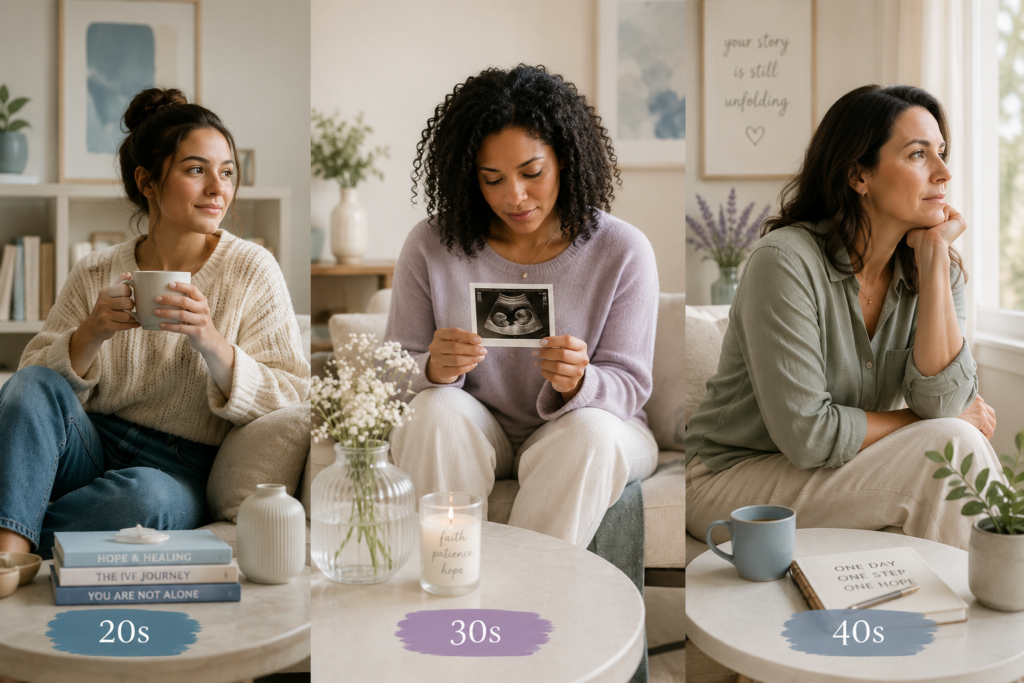
Fertility changes throughout your reproductive years, but age is not the only factor. Learn how infertility may look in your 20s, 30s, and 40s, what fertility testing can—and cannot—tell you, and when to see a specialist.
One of the first questions people hear when they are struggling to conceive is, “How old are you?” It carries a great deal of weight because most of us have repeatedly heard that fertility declines with age. That is true, but it is also an incomplete way to understand infertility.
Women in their 20s can need IVF because of severe endometriosis, blocked fallopian tubes, ovulation disorders, or male-factor infertility. Some women conceive naturally in their late 30s, while others build their families in their 40s through IVF, donor eggs, donor embryos, or other forms of fertility treatment. Age matters, but it cannot tell you everything about one person’s reproductive health.
Understanding how fertility generally changes from one decade to the next can help you make informed decisions without treating your birthday like a diagnosis.
Why Fertility Changes With Age
A woman is born with the eggs she will have throughout her lifetime. Both the number and reproductive potential of those eggs decline over time. Fertility is generally highest from the late teens through the late 20s, begins to decline around age 30, and decreases more rapidly during the mid-to-late 30s. (ACOG)
Age affects more than the number of eggs remaining. As eggs age, they are more likely to contain chromosomal abnormalities. An embryo created from a chromosomally abnormal egg may not implant, may result in miscarriage, or may lead to a pregnancy affected by a chromosomal condition. This is one reason conception becomes less likely and miscarriage becomes more common with increasing maternal age.
These are population-level patterns, not personal predictions. They explain what tends to happen across large groups but cannot tell one individual exactly how long conception will take or whether a particular cycle will result in pregnancy.
Fertility in Your 20s
The 20s are generally considered the years of highest reproductive potential. Egg quantity and quality are typically more favorable than they will be later, and healthy couples in this age group often have a higher chance of conceiving during each menstrual cycle.
According to ASRM patient education, a healthy, fertile 30-year-old has approximately a 20% chance of becoming pregnant in a given cycle. Monthly chances are generally favorable during the 20s as well, but a number such as 20% or 25% should never be treated as a guarantee. Even when no fertility problem exists, conception may take several months. (ReproductiveFacts.org)
Being young also does not provide protection from infertility. Polycystic ovary syndrome, endometriosis, blocked or damaged fallopian tubes, uterine conditions, thyroid disorders, irregular ovulation, genetic conditions, and previous cancer treatment can interfere with conception at any age. Sperm-related conditions can also contribute, either alone or alongside a female fertility factor.
Younger patients may respond more strongly to ovarian-stimulation medication and are generally more likely to produce chromosomally normal eggs than older patients. That can improve the likelihood of success with treatments such as ovulation induction, intrauterine insemination, or IVF when those treatments are appropriate. However, age cannot overcome every diagnosis. A woman in her 20s with blocked fallopian tubes, for example, has a very different situation from someone the same age who is not ovulating regularly.
If you are younger than 35 and have not conceived after 12 months of regular, unprotected intercourse, a fertility evaluation is recommended. Testing should begin sooner when there is a known condition or history that could affect fertility. (ASRM)
Fertility in Your Early 30s
Fertility does not suddenly disappear when someone turns 30. Many women conceive naturally and have healthy pregnancies throughout their early 30s. However, it is more accurate to say that fertility declines gradually during this period—not that it remains completely unchanged until age 35.
At age 30, a healthy, fertile woman has an estimated 20% chance of conceiving during one cycle. That percentage describes an average population, and an individual’s chances may be higher or lower depending on ovulation, sperm health, intercourse timing, reproductive anatomy, and other medical factors. (ReproductiveFacts.org)
If you hope to have more than one child, your current age is only part of the planning conversation. It is also worth considering how old you may be when you want to try for a second or third pregnancy. This does not mean you need to rush into treatment, but it may justify a preconception appointment or an honest discussion about your timeline.
Women under 35 are still generally advised to seek an infertility evaluation after 12 months of trying, unless they have irregular cycles, a known reproductive condition, recurrent pregnancy loss, previous pelvic surgery, or another reason for earlier testing.
Fertility After 35
Age 35 is not a cliff where fertility is normal one day and suddenly poor the next. It is a clinical threshold used because the decline in egg quantity and quality becomes more significant during the mid-to-late 30s, while the risk of miscarriage and chromosomal abnormalities increases.
Many women over 35 still conceive without treatment. The difference is that there is less time to spend trying without an evaluation if pregnancy does not happen. ASRM and ACOG recommend fertility testing after six months of regular, unprotected intercourse for women 35 and older. (ASRM, ACOG)
A fertility evaluation during this decade may include a review of menstrual cycles and medical history, confirmation of ovulation, assessment of the uterus and fallopian tubes, and a semen analysis for the male partner. Ovarian-reserve testing may include anti-Müllerian hormone, or AMH; antral follicle count, or AFC; and sometimes follicle-stimulating hormone, or FSH.
These tests are useful, but they are often misunderstood. AMH and AFC primarily help estimate the remaining follicle pool and how the ovaries may respond to fertility medication. They do not directly measure egg quality, and a low AMH result does not prove that natural conception is impossible. ASRM notes that ovarian-reserve markers are poor predictors of whether a woman without proven infertility will conceive naturally. (ASRM)
An abnormal result should therefore be interpreted alongside age, medical history, ultrasound findings, sperm health, and the length of time you have been trying—not used as a verdict on your ability to become pregnant.
Fertility in Your 40s
The 40s generally bring the most substantial changes in reproductive potential. Both the number of available eggs and the percentage likely to be chromosomally normal decline considerably. As a result, natural conception becomes less likely, miscarriage becomes more common, and IVF success rates using a patient’s own eggs decline.
ASRM estimates that by age 40, the chance of natural conception for a healthy woman is less than 5% per menstrual cycle. This does not mean pregnancy after 40 is impossible. It means it may take longer, the chance of success in each cycle is lower, and waiting many months before seeking information may narrow the available options. (ReproductiveFacts.org)
Some women in their 40s conceive naturally, while others use ovulation medication, IUI, IVF, donor eggs, or donor embryos. The appropriate path depends on age, ovarian reserve, sperm health, reproductive anatomy, treatment history, personal values, finances, and the number of children desired.
IVF success rates using a patient’s own eggs generally decrease with increasing age because egg age strongly affects embryo development and chromosomal health. Donor-egg outcomes are less dependent on the recipient’s age because the egg’s reproductive potential primarily reflects the donor’s age. The CDC therefore reports success rates for treatments using a patient’s own eggs by age group, while donor-egg results are not presented according to the recipient’s age. (CDC)
Donor eggs can increase the chance of treatment success for some patients, but they do not remove all pregnancy-related risks associated with being older. Pregnancy after 40 may require additional monitoring because risks such as hypertension, gestational diabetes, preeclampsia, and cesarean delivery increase with maternal age. A fertility consultation and a preconception medical evaluation can help separate the likelihood of creating a viable embryo from the health considerations involved in carrying a pregnancy.
If you are over 40 and want to become pregnant, ACOG recommends discussing evaluation before you begin trying, while ASRM states that more immediate evaluation and treatment may be warranted. (ACOG, ASRM)
What Age Cannot Tell You
Age is one of the strongest predictors of reproductive potential, but it cannot determine whether someone will conceive in a particular month or whether treatment will succeed. Two women of the same age can have very different menstrual patterns, diagnoses, ovarian responses, reproductive histories, and treatment outcomes.
Fertility is influenced by whether ovulation occurs, the condition of the fallopian tubes and uterus, endometriosis, PCOS, previous infections or surgeries, egg and sperm factors, sexual function, genetics, and overall health. In some cases, testing does not identify a clear cause, resulting in a diagnosis of unexplained infertility.
Male fertility should not be treated as an afterthought. A complete evaluation considers both partners because a woman’s age or ovarian-reserve result cannot explain every case of infertility. Beginning both evaluations at the same time can prevent months of unnecessary delay.
When Should You See a Fertility Specialist?
If the female partner is under 35 and no known fertility concern exists, an evaluation is generally recommended after 12 months of regular, unprotected intercourse without pregnancy. Beginning at age 35, evaluation is recommended after six months. For women over 40, a consultation before trying or as soon as trying begins is appropriate.
You should not wait for these time limits when periods are irregular or absent, endometriosis or tubal disease is suspected, there is a history of pelvic infection or reproductive surgery, or either partner has undergone chemotherapy or radiation. Earlier evaluation is also appropriate after recurrent pregnancy loss or when there is a known or suspected sperm, erectile, or ejaculation problem.
Seeking an evaluation does not commit you to IVF. The first goal is to understand what may be affecting conception. Depending on the results, the next step may involve timed intercourse, medication, surgery, IUI, IVF, donor treatment, or simply continuing to try with better information.
The Bottom Line
Age deserves an honest place in conversations about fertility, but it should not be used to frighten people or dismiss their individual circumstances. Being in your 20s does not make you immune to infertility, and being in your late 30s or 40s does not make pregnancy impossible.
What age changes most is time: how long it may be reasonable to try before seeking help, how urgently testing should happen, and which treatment options are most likely to work. You cannot control your age, but you can ask questions, request appropriate testing, involve both partners in the evaluation, and make decisions using accurate information instead of assumptions.
This article is for educational purposes and does not replace individualized medical advice.