


Let’s talk about the thing nobody warns you about at your first prenatal appointment: you are about to become extremely familiar with your underwear.
Somewhere around week six, you notice it. More discharge. Different discharge. Discharge that shows up like it pays rent now. And naturally, your brain — freshly marinated in pregnancy hormones and a healthy dose of “is this normal?” — spirals straight to Google.
Good news: in the vast majority of cases, more discharge during pregnancy is your body doing exactly what it’s supposed to do. Here’s the color-by-color, texture-by-texture breakdown, plus the specific signs that mean it’s time to actually pick up the phone.
Why there’s suddenly so much more of it
The medical term is leukorrhea, and it’s essentially your vagina’s in-house security system working overtime. Rising estrogen and increased blood flow to the pelvic area ramp up production of this thin, milky discharge, whose job is to help keep bacteria from traveling upward toward the uterus and to help form the mucus plug that seals off the cervix for the rest of the pregnancy. WebMD describes normal discharge during pregnancy as functioning this way — making it harder for infections to make the trip from vagina to womb, while rising progesterone helps drive the increase in volume.
So more discharge isn’t your body malfunctioning. It’s your body building a moat.
The color guide
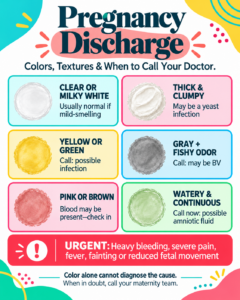
Clear or milky white. This is the textbook version of leukorrhea — thin, mild-smelling, and increasingly present as pregnancy progresses. The American Pregnancy Association describes this as the standard, unremarkable baseline: thin, white, milky, and mild-smelling. If this is what you’re seeing, no action needed beyond maybe a panty liner and a shrug.
Pale yellow. Still generally in “normal” territory, especially without odor or itching. But yellow is also the color that most often gets flagged in guides as worth a second look — particularly if it comes with a strong smell or irritation, since it can also signal a bacterial or yeast infection.
Pink or light spotting. This one causes the most panic and is, most of the time, the least dangerous. Light pink discharge can show up after sex (hello, more sensitive cervix), from implantation bleeding in early pregnancy, or — later on — as the famous “bloody show,” a pink or brown-tinged mucus that can appear hours to weeks before labor starts.
Brown. Usually just old blood making a delayed exit. According to ACOG, up to 20–30% of pregnant people experience some bleeding in the first trimester, and light brown spotting without heavy flow, severe pain, dizziness, or fever is generally something you can mention at your next appointment rather than rush in for.
Green, gray, or frothy. This is the “actually call someone” category. Green or gray discharge is widely flagged as a likely sign of infection — including STIs like trichomoniasis — especially when paired with a foul or fishy odor.
Thick and clumpy, like cottage cheese. Classic yeast infection territory. Uncomfortable, extremely common in pregnancy (thanks, hormonal shifts to your vaginal pH), and treatable — but worth confirming with your provider before self-treating, since not every over-the-counter option is recommended in pregnancy.
When it’s actually time to call
Set the group chat aside and call your OB or midwife if you notice:
- A strong, fishy, or foul odor — with or without a color change
- Green, gray, or frothy discharge
- Discharge that looks like cottage cheese, paired with itching or burning
- Heavy bleeding — soaking a pad in under an hour — or passing clots or tissue
- Fever or chills alongside any discharge change
- Pelvic pain, cramping, or pain during urination
- A sudden gush or steady trickle of watery fluid, which could be your water breaking, regardless of trimester
On that last one: if the fluid looks clear and mild-smelling, that’s the expected picture of amniotic fluid. But streaks of green or brown mixed into it are a same-day, don’t-wait call — that coloring can mean the baby has passed meconium in utero, which providers treat as a signal of possible fetal distress.
The general rule providers give, echoed across OB guidance: any sudden change — in color, consistency, smell, or accompanying sensation — is worth a call, even if it turns out to be nothing. Nobody in obstetrics has ever been mad at a patient for asking.
The lower-key takeaway
Most pregnancy discharge is boring in the best way — a sign your hormones are doing their job and your body is quietly defending its most important project. The goal isn’t to panic-Google every color shift; it’s to know your own baseline well enough to notice when something actually breaks the pattern. Cotton underwear, unscented liners if you want them, and your provider’s number saved somewhere easy to find. That’s really the whole system.
Sources:
- American College of Obstetricians and Gynecologists (ACOG), cited via ubiehealth.com, “First Trimester Brown Discharge: When to Call Your OB-GYN vs. When to Relax”
- American Pregnancy Association, “Vaginal Discharge During Pregnancy,” americanpregnancy.org
- WebMD, “What Is Vaginal Discharge?,” webmd.com
- The Bump, “Vaginal Discharge During Pregnancy: What to Know,” thebump.com
- Healthgrades, “Everything to Know About Pregnancy Discharge,” resources.healthgrades.com
This article is for general information and isn’t a substitute for medical advice — always check unusual symptoms with your own OB or midwife.