

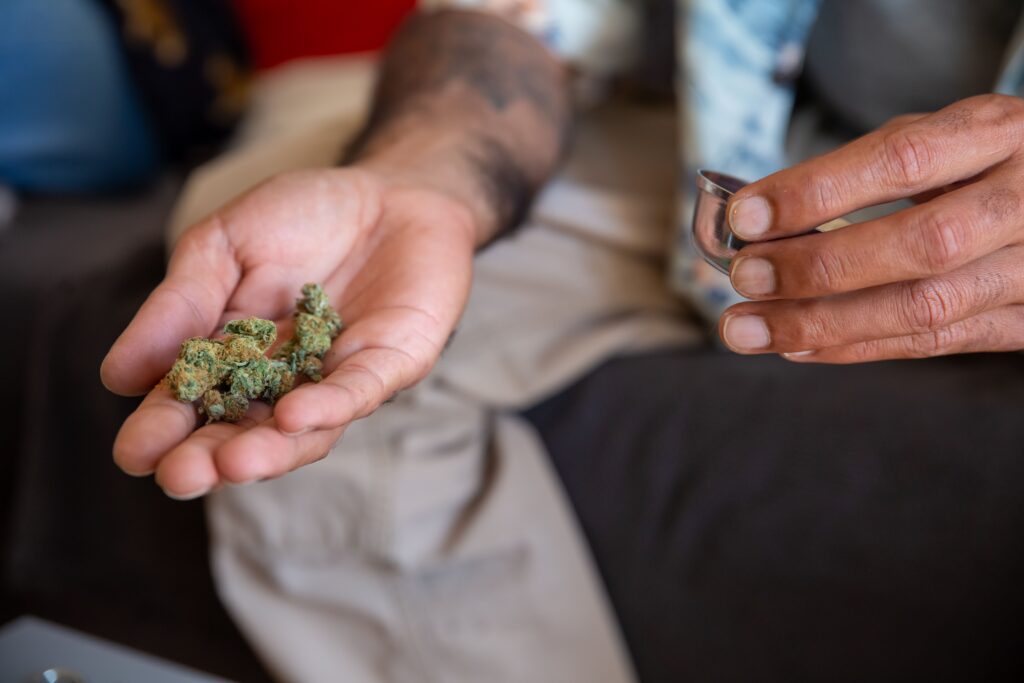
Cannabis is often treated like a harmless way to relax. But when a couple is trying to conceive, the question changes. It is no longer only about how weed makes someone feel. It is also about what cannabis may be doing to sperm during the roughly two-and-a-half months in which those cells are developing.
So, does weed affect male fertility?
The most accurate answer is: it may. Some studies have connected cannabis use—particularly frequent or heavier use—with lower sperm count or concentration, poorer movement, abnormal shape, and changes to chemical markers on sperm DNA. Other studies have found little or no meaningful difference. Researchers have also not consistently shown that male cannabis use causes a longer time to pregnancy or worse IVF outcomes.
That uncertainty does not prove cannabis is safe for fertility. It means the research is still limited and sometimes contradictory. For someone actively trying to conceive, especially when sperm quality is already a concern, reducing or stopping cannabis is a reasonable step that removes one potentially modifiable risk.
How Cannabis Could Affect Sperm
Cannabis contains many compounds, but tetrahydrocannabinol—better known as THC—is the one responsible for the “high.” THC interacts with the body’s endocannabinoid system. This system is involved in several reproductive processes, and cannabinoid receptors have been identified in sperm and within the male reproductive tract.
Because of that, researchers have examined whether cannabis can interfere with sperm production, maturation, movement, or its ability to fertilize an egg. The strongest concerns fall into five areas.
1. Sperm Count and Concentration
Sperm count is the total number of sperm in an ejaculate. Sperm concentration describes how many sperm are present in each milliliter of semen.
Some studies of men from the general population have linked marijuana use with lower sperm count and concentration. A systematic review published in The Journal of Urology concluded that semen parameters provide some of the strongest evidence for a negative effect of cannabis on male fertility, including possible reductions in sperm count and concentration.
But this finding is not universal. The American Society for Reproductive Medicine, or ASRM, reviewed the available research and found that studies involving men at infertility clinics have produced inconsistent results. Some found poorer semen measures, while others found no meaningful association.
In plain language: weed may lower sperm count in some men, but we cannot say that every man who uses cannabis will have a low count—or that cannabis is the only reason a count is low.
2. Sperm Motility
Motility refers to how well sperm move. Sperm need effective forward movement to travel through the reproductive tract and reach an egg.
Laboratory and observational research has raised concern that cannabis may reduce motility. However, the human studies are mixed. ASRM notes that recent or high-volume use was linked with abnormal motility in one study, while other fertility-clinic studies found no appreciable difference. One study even reported a lower risk of abnormal motility among current users—a result that demonstrates just how unsettled the evidence remains.
This does not mean cannabis improves sperm movement. It means study populations, doses, definitions of use, and other lifestyle factors make the results difficult to compare.
3. Sperm Morphology
Morphology describes sperm shape. A sperm cell is typically assessed by the appearance of its head, middle section, and tail. Abnormal morphology can make fertilization more difficult, although morphology alone does not determine whether someone is fertile.
Several studies reviewed by ASRM associated current or recent marijuana use with a higher likelihood of abnormal morphology. Other research found no association. As with count and motility, the evidence suggests a possible risk rather than a guaranteed effect.
4. Reproductive Hormones
Cannabis is sometimes blamed for lowering testosterone, but the human research does not support such a simple statement.
An early, small study reported lower testosterone among frequent marijuana users. Later and larger studies found no difference or even higher testosterone with more recent use. Findings involving luteinizing hormone, follicle-stimulating hormone, sex hormone-binding globulin, and inhibin have also varied.
The honest conclusion is that cannabis may interact with reproductive hormones, but there is no consistent hormonal pattern that applies to every user.
5. Sperm DNA and Epigenetic Changes
One of the newer concerns is not the DNA sequence itself, but the sperm’s epigenome—chemical markers that can help regulate whether certain genes are more or less active.
In a small human study, researchers found differences in sperm DNA methylation associated with cannabis use. After participants avoided cannabis for 77 days, many of those differences were reduced. Seventy-seven days was chosen to cover approximately one full cycle of sperm development.
This finding is worth paying attention to, but it should not be exaggerated. The study did not prove that paternal cannabis use causes a specific disease or developmental problem in a future child. It also did not establish that every cannabis-related change disappears after exactly 77 days. The research shows a possible biological effect and suggests that abstinence may reduce some of the observed differences.
Does Weed Make a Man Infertile?
Not necessarily.
Infertility is not diagnosed from cannabis use alone, and an abnormal semen-analysis result does not automatically mean a man cannot conceive. Semen values can change over time, and fertility depends on multiple factors involving both partners.
According to ASRM, marijuana use has not been consistently associated with male fecundability—the probability of achieving pregnancy in a menstrual cycle—time to pregnancy, semen parameters, reproductive hormones, or assisted-reproduction outcomes. Research on male cannabis use and IVF outcomes is especially limited, with small numbers of exposed participants and conflicting findings.
That distinction matters:
- Evidence that cannabis may alter sperm is not the same as proof that cannabis causes infertility.
- A normal semen analysis does not prove cannabis has no effect on sperm function or DNA markers.
- A poor semen analysis cannot be blamed on cannabis without evaluating other possible causes.
Does the Method Matter—Smoking, Vaping, or Edibles?
Researchers do not yet have enough high-quality evidence to rank smoking, vaping, and edibles by their effects on male fertility.
Avoiding smoke may reduce exposure to combustion products, but switching from smoking to edibles does not remove THC exposure. Vapes and concentrates can also deliver high doses of THC. Many human studies rely on participants reporting whether they use marijuana without consistently documenting the product, potency, dose, frequency, or route.
Therefore, changing the delivery method should not be treated as a proven fertility fix. If THC is contributing to the problem, an edible is not automatically harmless simply because there is no smoke.
Does Frequency Matter?
It probably does, but researchers have not identified a universally safe amount.
Some findings suggest a dose-response relationship, meaning heavier or more frequent exposure may be associated with a greater effect. Yet cannabis products now vary enormously in THC concentration, and “one use” is not a standardized dose. A person taking one low-dose edible per month and someone using a high-potency concentrate several times a day should not be grouped together, even though some studies effectively do that.
For fertility planning, daily or near-daily use deserves more concern than rare use. But “occasional” should not be translated into “proven safe.”
How Long After Quitting Weed Might Sperm Improve?
New sperm take approximately 74 days to develop, followed by additional time for maturation and transport. That is why fertility clinicians often think in periods of roughly three months when discussing lifestyle changes.
The study on sperm DNA methylation used 77 days of cannabis abstinence and found that many cannabis-associated differences were reduced after that period. Based on sperm biology and the limited available evidence, avoiding cannabis for at least one full sperm-development cycle—roughly 11 weeks, or about three months—is a reasonable precaution before trying to conceive or providing a sperm sample for treatment.
That timeline is not a guarantee. Improvement depends on the individual, the amount and duration of prior use, overall health, and the cause of any abnormal semen results. Some people may need longer, and quitting cannabis will not correct a fertility problem caused by another medical condition.
What If You Are Trying to Conceive Now?
If pregnancy is the goal, this is the practical approach:
- Be honest about use. Tell the reproductive endocrinologist, urologist, or primary-care clinician what product is used, how often, and when it was last used. The purpose is accurate care, not judgment.
- Consider stopping for about three months. This covers approximately one sperm-production cycle and removes a potentially modifiable exposure.
- Do not assume switching products solves the issue. Smoking, vaping, gummies, tinctures, and concentrates can all expose the body to THC.
- Request a semen analysis when appropriate. A semen analysis measures factors such as volume, concentration, movement, and shape. One abnormal result may need to be repeated because semen values naturally fluctuate.
- Address the rest of the picture. Nicotine, anabolic steroids or testosterone therapy, heavy alcohol use, certain medications, heat exposure, infections, varicocele, obesity, and medical conditions may also affect fertility.
- Get evaluated instead of waiting indefinitely. In general, seek a fertility evaluation after 12 months of trying when the egg-producing partner is under 35, or after 6 months when that partner is 35 or older. Earlier evaluation may be appropriate with known risk factors, irregular cycles, previous reproductive problems, or suspected male-factor infertility.
Do not stop a prescribed cannabinoid medication—or use cannabis to manage a medical condition—without discussing alternatives with the clinician who manages that condition.