

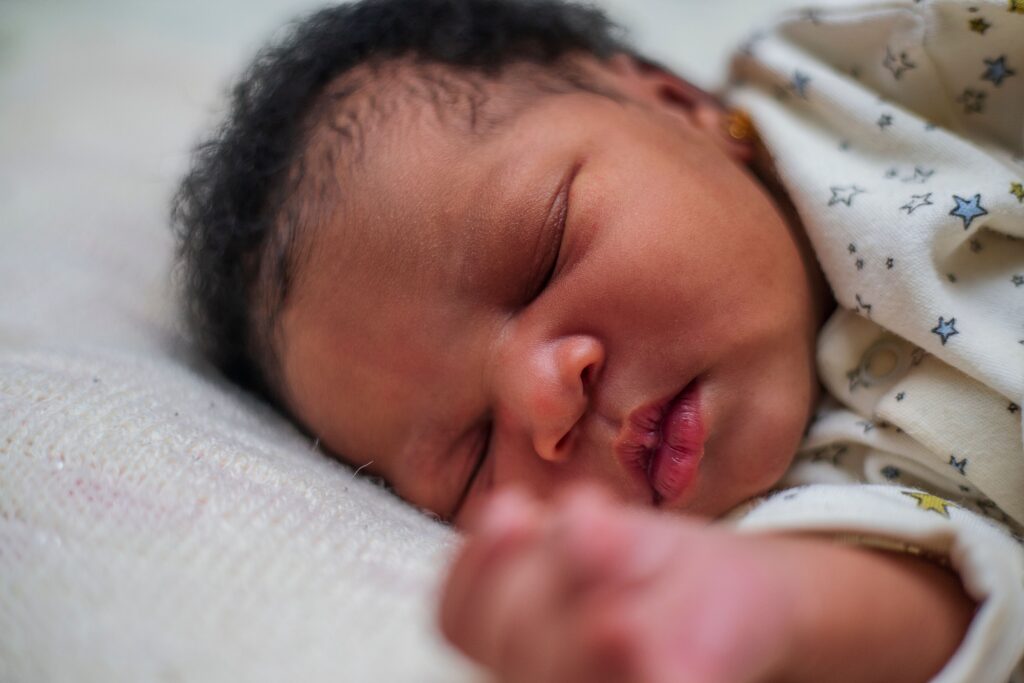
A few weeks into motherhood, I discovered something nobody adequately prepares you for: newborns are loud.
Not crying loud. Not screaming loud. Just… noisy.
Before Dreico was born, I imagined newborn sleep as peaceful. Maybe a few cute little sighs. Maybe some gentle cooing. What I got instead was an entire sound effects library — grunting, snorting, squeaking, whistling, and the occasional dramatic breath that made me sit straight up in bed and ask AJ, “Did you hear that?”
The strangest part was that most of these noises happened at night. During the day, Dreico seemed perfectly normal — eating well, gaining weight, acting like a healthy baby. But once nighttime arrived, he transformed into what I can only describe as a tiny farm animal.
As a first-time mom, I immediately assumed something was wrong. As it turns out, many newborns make strange noises while they sleep, and most of those noises are completely normal.
Why are newborns so noisy?
Unlike adults, newborns have incredibly small airways and nasal passages — tiny noses, tiny throats, tiny breathing passages. Because those passages are so small, even a little mucus creates noticeable sound. Think about blowing air through a coffee stirrer versus a paper towel tube: the smaller the opening, the louder and more dramatic the sound.
There’s real anatomy behind that comparison. In newborns, the nasal passages can account for as much as half of the baby’s total airway resistance — so a small amount of narrowing does a lot more acoustic work in a newborn than it would in an older child or adult. That’s one reason newborns often sound congested even when they aren’t actually sick — their anatomy simply makes normal breathing louder.
Why does it sound worse at night?
Several things stack up here.
The house is quieter. During the day, household noise — the TV, conversation, dishes, the dog — masks a lot of what babies do. At night, all of that disappears, so every grunt sounds louder and every squeak feels like it needs investigating.
Babies sleep on their backs. The American Academy of Pediatrics recommends back sleeping for every sleep because it’s the position most protective against Sudden Infant Death Syndrome (SIDS), and it’s genuinely the safest way for babies to sleep. But lying flat can change how mucus settles in the nasal passages, which can make congestion sounds more noticeable than they’d be upright.
Dry air doesn’t help. Air conditioning and heating systems can pull humidity well below comfortable levels, and dry nasal passages tend to produce thicker, more noticeable mucus — which means congestion sounds often get louder overnight, right when the house has gone quiet enough to actually hear them.
Is my baby actually congested?
Not necessarily — this was one of the biggest surprises for me. A baby can sound congested without having significant congestion at all. True congestion tends to come with additional signs: visible mucus, difficulty feeding, increased fussiness, trouble breathing through the nose, or poor sleep. Plenty of newborns simply make noisy breathing sounds because their airways are small and still developing — the sound alone doesn’t always mean there’s a problem.
Why are babies called “obligate nose breathers”?
You’ll hear this phrase constantly in newborn care, and it’s the real reason nasal congestion feels like such a big deal in the early months. Newborns strongly prefer — and for practical purposes, rely on — breathing through their noses for roughly the first several months of life, commonly cited as somewhere between 2 and 6 months depending on the source and the individual baby. That preference is actually a neat piece of design: it lets a baby breathe and swallow at the same time while feeding, without choking.
The tradeoff is that even a small amount of mucus can feel like a much bigger deal than it would in an older child, because switching over to mouth breathing isn’t as instant or automatic for a newborn as it is for us. (Some newer research has actually pushed back on the word “obligate” — testing shows most neonates can mouth-breathe if their nose is fully blocked, they just don’t transition to it quickly or reliably. Functionally, for a parent at 2 a.m., the practical takeaway is the same: newborns are strongly nose-dependent, and nasal blockages deserve real attention.)
What can parents do?
If your baby seems mildly congested but is otherwise healthy, a few simple things help:
- Use a cool-mist humidifier to keep the air from drying out nasal passages further
- Try saline drops to loosen dried mucus
- Use gentle suction — a bulb syringe or nasal aspirator — if you can actually see mucus
- Watch how feeding goes. A baby who feeds well is usually a reassuring sign; difficulty feeding is one of the bigger things worth paying attention to
When should parents actually worry?
Most newborn congestion is harmless. But contact your pediatrician if your baby:
- Has a fever
- Is breathing rapidly, or has visible pauses in breathing
- Has chest retractions (the skin pulling inward with each breath)
- Appears blue around the lips
- Refuses to feed
- Seems unusually sleepy or is difficult to wake
Those signs are the ones that separate “normal newborn noise” from something that deserves same-day medical evaluation.
What was my experience?
For several nights, I found myself listening to Dreico breathe instead of sleeping. Every grunt sent me into detective mode. Every squeak required investigation. Every deep breath became a research project.
The funny part is that by morning he’d be perfectly fine — eating normally, gaining weight, acting exactly like the healthy baby his pediatrician said he was. Meanwhile, I’d spent the night mentally preparing for every diagnosis Google could invent.
Eventually I realized something important: sometimes newborns are just noisy. Not sick. Not struggling. Not in distress. Just noisy. I still pay attention to changes in his breathing — but I’ve stopped assuming every barnyard sound is an emergency.
Newborn dictionary
Congestion — a buildup of mucus in the nasal passages. Nasal passages — the airways inside the nose that carry air to the lungs. Humidifier — a device that adds moisture to the air. Saline drops — a saltwater solution used to loosen mucus. Obligate nose breather — a baby who primarily breathes through the nose during early infancy.
Quick facts
- Newborns typically sleep 14–17 hours per day
- Babies primarily breathe through their noses for roughly the first several months of life
- Small nasal passages make normal breathing sound louder — nasal passages can account for up to half of a newborn’s total airway resistance
- Most newborn congestion isn’t caused by illness
- Dry indoor air can make congestion sounds more noticeable
What I learned
Newborns are much noisier than I expected. Not every strange sound means something is wrong. Google has terrible bedside manner. A baby who is feeding and growing well is reassuring. And tiny farm animal noises are often just a normal part of newborn life.
Farm animal sound tracker: ✔ Grunt · ✔ Snort · ✔ Squeak · ✔ Random dramatic breath · ✔ Scared Mom for absolutely no reason
Congratulations. Your newborn is probably functioning exactly as designed.
Sources:
- American Academy of Pediatrics (AAP), “Consultation with the Specialist: Diagnosis and Management of the Newborn with Nasal Obstruction,” publications.aap.org
- Contemporary Pediatrics, “Relieving Nasal Obstructions in Neonates,” contemporarypediatrics.com
- Don’t Forget the Bubbles, “Are Infants Really Obligate Nasal Breathers?,” dontforgetthebubbles.com
- Doctronic, “Why Does My Newborn Sound Congested?,” doctronic.ai
- Let Mommy Sleep, “Newborn Breathing Patterns: What’s Normal?,” letmommysleep.com
This article is for general information and isn’t a substitute for medical advice — always check unusual breathing symptoms with your child’s pediatrician.