

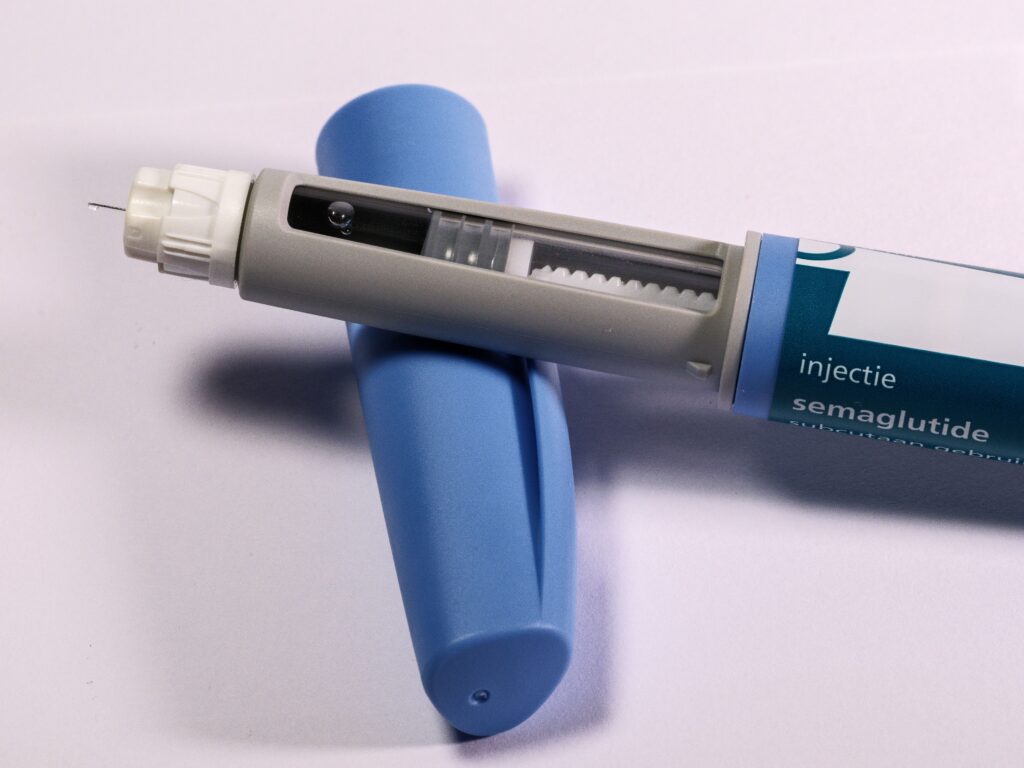
If your feed has shown you one “surprise! I’m pregnant” story from someone on Ozempic for every ten weight-loss transformation posts, you’re not imagining a trend. “Ozempic babies” has become an actual phrase people search, and like most viral fertility phenomena, the real story is less magic and more biology — plus one detail worth knowing before you TTC.
Here’s what’s actually going on with GLP-1 medications (semaglutide — Ozempic, Wegovy, Rybelsus; and tirzepatide — Mounjaro, Zepbound) and fertility, minus the group-chat speculation.
Why they might help fertility in the first place
GLP-1 medications weren’t designed with fertility in mind — they were built for blood sugar control and weight management. But for a specific group of people, especially those with PCOS or insulin resistance, the mechanism happens to overlap with what’s blocking ovulation in the first place.
Here’s the chain: chronically high insulin signals the ovaries to overproduce androgens like testosterone, and elevated androgens are a major reason ovulation becomes irregular or stops altogether in conditions like PCOS. By improving insulin sensitivity and driving weight loss, GLP-1s can lower circulating insulin, which can reduce androgen production and let ovulation return. Clinically, even weight loss as modest as 5–10% of body weight has been enough to help menstrual cycles regularize and ovulation resume in some patients.
So the “fertility benefit” isn’t the drug doing something reproductive directly — it’s the drug treating the metabolic issue that was suppressing ovulation. That distinction matters for what comes next.
The “Ozempic babies” thing, explained
The unplanned-pregnancy stories cluster around a genuinely predictable pattern, not a mystery: ovulation returns before a period does. Because ovulation happens roughly two weeks before menstruation, someone whose cycles restart can conceive on their very first restored cycle without ever seeing a baseline period return as a warning sign first. Add in a second, less-discussed factor — some research and clinical guidance notes that certain GLP-1s may reduce the effectiveness of oral birth control, likely related to how these drugs slow stomach emptying and can affect how oral medications are absorbed — and you get a population that’s more fertile than expected, with a contraceptive method that may be working less reliably than expected, at the same time. That combination is the actual mechanism behind the trend, not some fertility-boosting magic in the injection itself.
Why you can’t just stay on it while TTC
This is the part that gets lost in the “it fixed my PCOS” success stories: none of the currently approved GLP-1 medications are considered safe during pregnancy, and the guidance is consistent across manufacturers and specialists on stopping before you conceive, not after.
Human pregnancy data is genuinely limited, largely because people who become pregnant during clinical trials are taken off the medication immediately rather than continuing on it for research purposes. What data does exist, per current reporting, hasn’t shown a clearly elevated fetal risk compared with other options like insulin — but animal studies have raised enough developmental concerns that every GLP-1 carries a contraindication for pregnancy, and regulators aren’t treating “no clear signal yet” as the same as “cleared for use.”
The FDA-labeled washout periods, per current prescribing guidance:
- Semaglutide (Ozempic, Wegovy, Rybelsus): stop at least 2 months before a planned pregnancy
- Tirzepatide (Mounjaro, Zepbound): commonly cited around 1 month before attempting pregnancy, per current clinical guidance, though fertility clinics vary in how conservative they are here
- Liraglutide (Saxenda and other brands): clears the body faster and is generally advised to stop just before trying to conceive
If you’re pursuing IVF specifically, the timeline gets an extra layer: because egg retrieval involves sedation, and GLP-1s slow stomach emptying — which raises the risk of reflux or regurgitation under anesthesia — some fertility clinics recommend stopping at least 4 weeks before the retrieval procedure itself, separate from the longer pregnancy-specific washout.
If you get pregnant while still on one
It happens, and it’s not a reason to panic. The consistent guidance across fertility and OB sources: stop the medication as soon as pregnancy is confirmed, and tell your prescribing doctor and your OB or fertility team right away so they can monitor things appropriately. The advice to stop isn’t rooted in a known bad outcome — it’s rooted in “not enough data to say it’s fine,” which is a very different (and much less alarming) thing.
The practical version, if you’re planning ahead
- If you’re using a GLP-1 for PCOS or weight-related fertility support, that’s a legitimate preparation-phase tool, not a TTC-phase one
- Talk to your prescribing doctor about your specific washout timeline before you start trying — semaglutide and tirzepatide aren’t identical here
- Don’t rely on oral birth control alone while on a GLP-1 if you’re not currently trying to conceive; ask about backup methods
- If your cycles restart while you’re still on the medication, know that ovulation can beat your first period back — protect accordingly
- If a positive test surprises you mid-treatment, stop the medication and call your provider — this is a “loop in your team” moment, not an emergency
Sources:
- U.S. News & World Report, “GLP-1s and Reproductive Health: What to Know About ‘Ozempic Babies,'” health.usnews.com
- SkinnyRx, “GLP-1 Medications and Pregnancy: Safety Guidelines, Risks, and What to Know About ‘Ozempic Babies,'” skinnyrx.com
- The Dietologist, “Ozempic, Wegovy and Mounjaro: What to Know About GLP-1 Medications Before Trying to Conceive,” thedietologist.com.au
- Evewell Fertility, “GLP-1 Medications, Fertility and IVF,” evewell.com
- Marc Sklar, “GLP-1 Medications, Ozempic & Fertility: What to Know,” marcsklar.com
- SEEN Fertility, “Weight Loss Injections, Mounjaro & IVF,” seenfertility.com
This article is for general information and isn’t a substitute for medical advice — GLP-1 and pregnancy timing decisions should always be made with your prescribing doctor and your OB or fertility specialist together.