


Congratulations, you now own a laundry pile that smells faintly of sour milk and never fully goes away. Welcome to spit-up season.
Almost every baby does it, most parents lose at least one “nice” outfit to it in the first month, and it is — brace yourself — usually completely fine. But “usually” is doing some work in that sentence, and there are a handful of colors and patterns that mean it’s time to stop scrolling and start dialing. Here’s the actual breakdown.
Spit-up vs. vomiting: not the same thing
First, the vocabulary that matters more than you’d think. Spit-up drips or dribbles out, often with a burp, and doesn’t seem to bother your baby much. Vomiting is forceful — it comes out with actual effort, sometimes in an arc — and tends to come with visible distress. Healthline draws that same line: normal spit-up is generally handled at home with no doctor visit needed, while true vomiting, or spit-up that increases over time or continues past 12 months, is what earns a call.
The distinction matters because the volume of spit-up freaks parents out way more than it should, while the force and color are the things actually worth tracking.
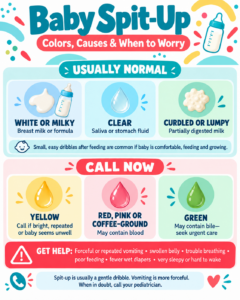
The color guide
White, milky, or slightly curdled. This is the standard. It’s just recently eaten milk that met stomach acid on its way back up — totally normal, especially right after a feed or during a burp.
Clear. Also generally unremarkable. Clear spit-up often shows up between feeds or is just extra saliva, particularly during teething or if your baby has some congestion going on.
Yellow. Usually still within normal range, sometimes tied to something in mom’s diet if breastfeeding, or simply how the milk broke down. It becomes worth watching if it shows up alongside poor weight gain, dehydration signs, or repeated projectile episodes, since one pediatrician-reviewed source notes that persistent or worsening symptoms alongside yellow spit-up warrant medical attention.
Green. This is a legitimate “call the doctor” color. Green or yellow-green coloring usually means bile has mixed in — and bile in vomit is widely flagged across pediatric sources as a reason for urgent evaluation, since it can point to a blockage or obstruction further down the digestive tract.
Pink, red, or rust-colored. Translation: there’s blood involved. The most common and least scary explanation, especially in breastfed babies, is that your baby swallowed a small amount of blood from a cracked or bleeding nipple during nursing — not their blood at all. But if it’s more than a tiny fleck, keeps recurring, or shows up with fussiness, poor feeding, or lethargy, it’s time to call rather than guess.
Dark brown, like coffee grounds. This usually means older, digested blood, and multiple pediatric sources treat it as an emergency-level sign rather than a “mention it at the next visit” one — head to urgent care or the ER rather than waiting.
The one everyone should actually know: projectile vomiting
A wet burp that dribbles down the chin is spit-up. A stream of milk launching a foot or more across the room is a different category entirely. Forceful, repeated projectile vomiting — especially in a baby between 2 and 8 weeks old, worsening over days, and paired with the baby seeming hungry again immediately after — is the hallmark of a condition called pyloric stenosis, a narrowing of the valve between the stomach and small intestine. It’s treatable, it’s surgical, and it’s one of the more common reasons newborns need surgery, so pediatric hospital systems are consistent on this point: forceful, projectile vomiting is a same-day call to your child’s doctor, not a wait-and-see situation.
When to actually call
Put the “is this normal” spiral away and call your pediatrician if you see:
- Green or yellow-green vomit (possible bile)
- Blood — pink, red, rust, or coffee-ground brown
- Forceful, projectile vomiting, especially if it’s happening more than once a day
- Signs of dehydration — fewer wet diapers, a dry mouth, a sunken soft spot, or unusual sleepiness
- Poor weight gain or weight loss
- Fever, lethargy, or a baby who seems genuinely uncomfortable rather than just messy
- Spit-up that’s increasing over time, or that’s still happening well past the baby’s first birthday
The reassuring part
The overwhelming majority of spit-up is just gravity, an immature little valve at the top of the stomach doing its best, and a baby figuring out how eating works. Most babies grow out of the heavy spit-up phase by around their first birthday as that valve matures. Keep baby upright after feeds, burp more than you think you need to, and save your judgment calls for the signs above — not the volume on your burp cloth.
Sources:
- Healthline, “Baby Spit Up: Is Spitting Up This Much Normal?,” healthline.com
- HealthyChildren.org (American Academy of Pediatrics), “Hypertrophic Pyloric Stenosis (HPS),” healthychildren.org
- KidsHealth from Nemours, “Pyloric Stenosis,” kidshealth.org
- Seattle Children’s Hospital, “Pyloric Stenosis,” seattlechildrens.org
- Enfamil, “Why Is My Baby Spitting Up Clear Liquid?,” enfamil.com
- Parenting Mentor, “Blood in Baby Spit Up: When to Call the Doctor,” parentingmentor.com
This article is for general information and isn’t a substitute for medical advice — always check unusual symptoms with your child’s pediatrician.